This page contains affiliate links. If you purchase through them we may earn a small commission at no extra cost to you. Learn more
Right to Roam in the UK: CRoW Act and Access Rights Explained
Legal disclaimer
This is general information, not legal advice. Laws change — verify current legislation before acting on anything you read here.
Quick Summary
- The CRoW Act 2000 gives you the right to walk on mapped 'access land' in England and Wales — but not to cycle, camp, or ride horses
- Scotland's Land Reform Act 2003 provides much broader access rights including [wild camping](/guides/wild-camping)
- Access rights come with responsibilities — you can lose them if you abuse them
What Is the Right to Roam?
"Right to roam" is the popular term for the legal rights that allow you to access certain land for recreation without needing the landowner's permission. In the UK, these rights vary significantly depending on where you are.
The term gets thrown around a lot, and people often assume it means you can go anywhere and do anything. It doesn't. But what it does provide is genuinely valuable — legal access to some of the best landscapes in the country.
England and Wales: The CRoW Act
The Countryside and Rights of Way Act 2000 (CRoW Act) is the key legislation for access rights in England and Wales. It created a new right of public access on foot to certain types of land.
What Is Access Land?
Access land under the CRoW Act includes:
- Mountain land — defined as land above 600 metres that's predominantly open and uncultivated
- Moor — open and uncultivated moorland
- Heath — open heathland
- Down — chalk and limestone downland
- Registered common land — land registered as common under the Commons Registration Act 1965
All access land is mapped by Natural England and Natural Resources Wales. You can check whether land is access land using their online mapping tools or OS maps, where access land is shown with a yellow tint and orange boundary.
What Can You Do on Access Land?
The right of access allows you to:
- Walk across the land
- Run, climb, and explore on foot
- Sit, rest, and observe wildlife
- Birdwatch, sketch, or photograph
Essentially, any open-air recreation that you do on foot.
What Can't You Do?
The CRoW Act specifically excludes several activities:
- Camping — not covered by the right of access
- Cycling — not permitted on access land (unless there's a separate right of way)
- Horse riding — not included (unless it's registered common land with existing riding rights)
- Driving any vehicle — obviously not
- Lighting fires — restricted on access land
- Taking animals other than dogs — not covered
- Organised games or commercial activities — not permitted without agreement
- Hunting, shooting, or fishing — not included
The right to roam does not include cycling, camping, or horse riding on access land. If you want to do any of these, you need a separate legal basis — either a public right of way, landowner permission, or (in Scotland) the broader access rights.
Dogs on Access Land
You can take dogs on access land, but with restrictions:
- Dogs must be on a short lead (no more than 2 metres) near livestock between 1 March and 31 July, and at all times near livestock
- Dogs must be kept under close control at all other times
- Landowners can exclude dogs from grouse moor and lambing land for up to 28 days a year
Restrictions and Exclusions
Landowners and the relevant authorities can restrict or exclude access on CRoW access land for specific reasons:
- Land management — grouse shooting, conservation work
- Fire risk — during dry conditions
- Safety — military training, dangerous conditions
- Nature conservation — protecting breeding birds, sensitive habitats
Restrictions are usually temporary and seasonal. They're published on the Open Access website and sometimes signed on the ground.
Public Rights of Way
Separate from access land, public rights of way (footpaths, bridleways, and byways) give you the right to travel along a defined route across any land — including private land. These are shown on OS maps and are maintained by local authorities.
- Footpaths: Walking only
- Bridleways: Walking, horse riding, and cycling
- Restricted byways: Walking, horse riding, and non-motorised vehicles
- Byways open to all traffic (BOATs): All of the above plus motor vehicles
Public rights of way and CRoW access land are separate systems. You might have a footpath across land that isn't access land, or access land with no defined paths.
Scotland: A Different Approach
Scotland's access rights under the Land Reform (Scotland) Act 2003 are significantly broader than England and Wales. The right of responsible access applies to most land and inland water and includes:
- Walking, cycling, and horse riding
- Wild camping
- Canoeing and kayaking on rivers and lochs
- Crossing any land (with certain exclusions)
The key differences from the CRoW Act:
| England & Wales (CRoW) | Scotland (Land Reform Act) | |
|---|---|---|
| Applies to | Mapped access land only | Most land and inland water |
| Walking | Yes | Yes |
| Cycling | No | Yes |
| Horse riding | No (limited exceptions) | Yes |
| Camping | No | Yes (responsibly) |
| Water access | Limited | Yes |
Scotland's rights are exercisable only if done responsibly, as set out in the Scottish Outdoor Access Code. See our Scottish wild camping guide for camping-specific details.
Northern Ireland
Northern Ireland doesn't have equivalent right-to-roam legislation. Access to the countryside depends on public rights of way, permissive paths, and land managed for public access (such as forestry and National Trust land). Campaigns for access reform in Northern Ireland are ongoing.
The Right to Roam Campaign
There's an active campaign to extend access rights in England and Wales to match or approach Scotland's model. The Right to Roam campaign advocates for:
- Extending the CRoW Act to include rivers, lakes, woods, and green belt land
- Including cycling, camping, and swimming in access rights
- Simplifying the system of access land mapping
Whether this results in legislative change remains to be seen, but it's a significant and growing movement.
Practical Tips
- Check OS maps before heading out. Access land is clearly marked with a yellow wash.
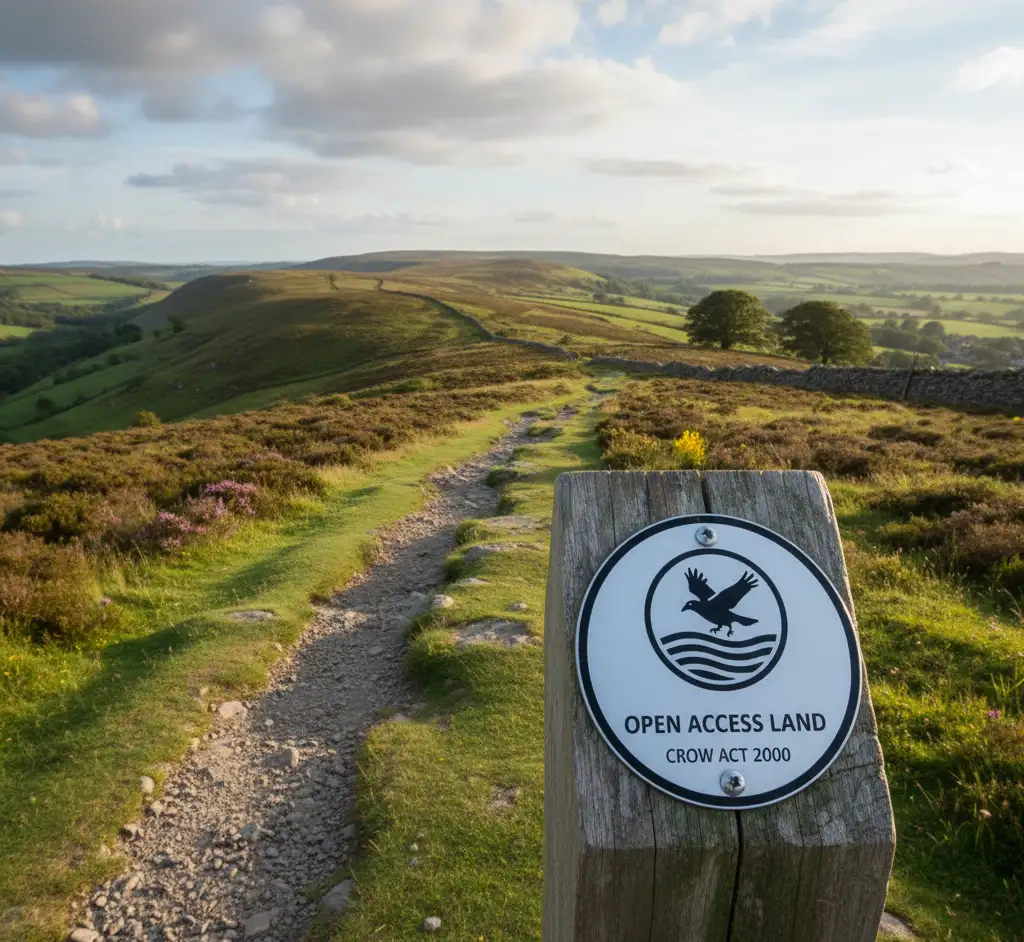
- Look for signs. Access land often has entrance signs showing the walking figure symbol.
- Respect restrictions. If land is temporarily excluded, don't access it — the restriction exists for a reason.
- Follow the Countryside Code. Respect, protect, enjoy. Close gates, take your litter, keep dogs under control.
- Know which country you're in. If you're near the English-Scottish border, the rules change when you cross it.
The CRoW Act access land, combined with the extensive public rights of way network, gives you access to a huge amount of the English and Welsh countryside. It's not perfect, but it's more than many people realise.
Making the Most of Access Land
Access land is genuinely brilliant once you know where it is and what you can do on it. The best way to explore it is with proper navigation tools — digital or analogue. OS maps mark access land clearly, and having a compass means you can confidently navigate open moorland where paths may be faint or absent.
One of the joys of access land is that you don't have to follow a path. Unlike a public right of way, which follows a defined line on the map, access land lets you wander freely on foot. Head for the ridge that looks interesting, explore the stream valley, or just sit on a rock and watch the world go by. It's open-air recreation at its best.
Essential Kit for Access Land Walking
Silva Ranger Compass
Amazon UKBaseplate with mirror
1:25k and 1:50k
Adjustable
52g
Pros
- +Reliable navigation without batteries
- +Mirror for accurate bearings on open ground
- +Luminous markings for low light
Cons
- −Takes practice to use well with a map
The classic navigation companion for access land walking. Pair it with an OS map and you can confidently explore open moorland without relying on your phone.
View dealAffiliate link — we may earn a small commission at no extra cost to you
Ordnance Survey Explorer Map (1:25,000)
Amazon UK1:25,000
Varies by sheet
Access land marked in yellow
Paper (Active versions are waterproof)
Pros
- +Shows access land boundaries clearly
- +Detailed footpath and terrain information
- +No battery required
Cons
- −Paper versions aren't waterproof (go for Active edition)
- −Need the right sheet for your area
The definitive walking map for England and Wales. Access land is shown with a yellow tint so you know exactly where your right to roam applies.
View dealAffiliate link — we may earn a small commission at no extra cost to you
Osprey Daylite Plus Daypack (20L)
Amazon UK20 litres
570g
Mesh ventilated
All Mighty Guarantee
Pros
- +Light and comfortable for day walks
- +Multiple pockets for organising kit
- +Osprey's lifetime guarantee
Cons
- −No rain cover included
A brilliant daypack for access land exploring. Light enough that you forget you're wearing it, but structured enough to carry everything you need for a full day out.
View dealAffiliate link — we may earn a small commission at no extra cost to you
Ready to gear up?
Use our kit builder to get a complete packout list tailored to your trip type, terrain, and budget — with prices and buy links.
Related reading
UK Outdoor Law and Safety — Your Complete Practical Guide
A plain-English guide to UK outdoor laws covering wild camping, knife law, foraging, right to roam, drones, and campfires.
Wild Camping Law in England & Wales: What's Actually Legal
The legal position on wild camping in England and Wales — trespass, landowner permission, and how to camp responsibly without getting moved on.
Wild Camping Law in Scotland: Your Right to Roam and Camp
Scotland's wild camping rights under the Land Reform Act 2003 and Scottish Outdoor Access Code — what you can do, where you can camp, and your responsibilities.
Trespass Law in the UK: Civil vs Criminal Trespass Explained
What happens if you trespass in the UK — civil trespass explained, aggravated trespass, and what landowners can and can't do.